
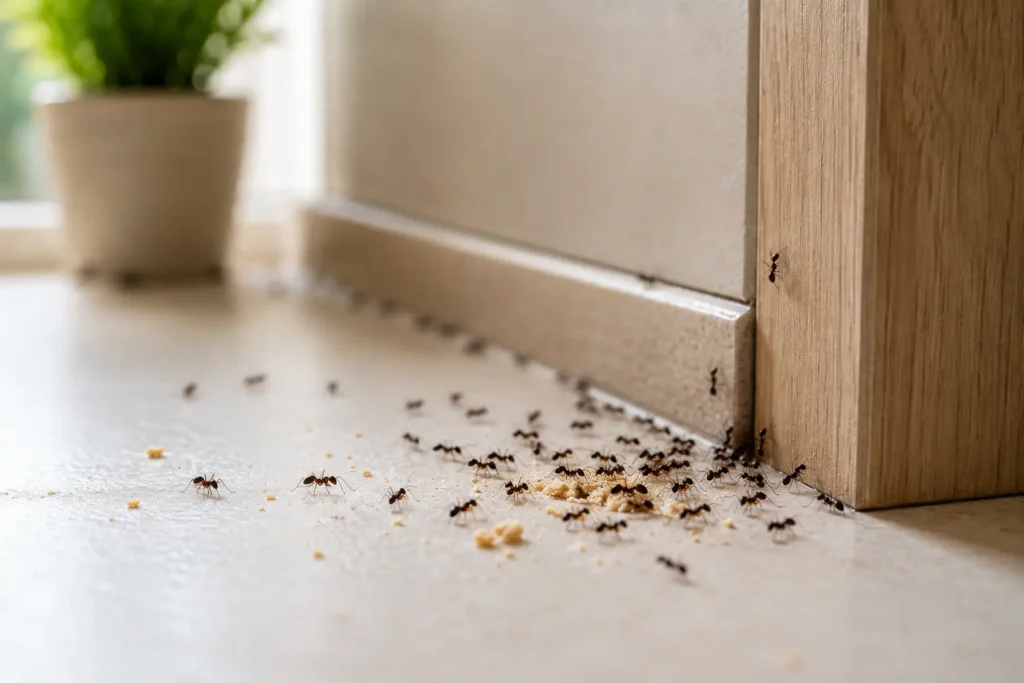
You spot one ant on your kitchen counter. You squish it and move on. Then an hour later there are six more in the same spot. By the next morning there’s a line of them marching from the window to the back of your pantry. If you’ve ever wondered what attracts ants to your house in the first place, you’re asking exactly the right question — because solving an ant problem starts with understanding why they showed up at all.
The truth is, ants don’t wander into your home randomly. They’re sent in by scouts searching for something specific, and once they find it, the whole colony follows. Here’s exactly what draws them in and what you can do to make your home far less inviting.
What Attracts Ants to Your House?
Ants are driven by three basic needs — food, water, and shelter. Your home offers all three, often without you realizing it.
What actually happens when ants appear indoors is a remarkably organized process. A scout ant leaves the colony and explores the surrounding area looking for resources. When it finds something useful — a crumb, a spill, a damp area under the sink — it returns to the nest leaving behind an invisible chemical trail called a pheromone. Other ants in the colony follow that trail straight to the source. That’s why a single ant on your counter in the morning can become a full line of them by afternoon.
The most common things that attract ants to a house include:
- Food left out on counters or in unsealed containers
- Sweet smells from juice spills, sugar, syrup, or overripe fruit
- Greasy residue on stovetops or behind appliances
- Pet food left in open bowls
- Moisture from leaky pipes, damp basements, or wet sponges
- Warmth during cold or wet outdoor conditions
- Cracks and gaps that provide sheltered entry points
Most homeowners focus on the food aspect and miss the moisture piece entirely. During dry summer periods, ants will specifically seek out water sources — a dripping tap, condensation on a pipe, or even a wet sponge left by the sink is enough to bring them inside.
What Attracts Ants in the Kitchen?
The kitchen is ground zero for ant activity in most homes, and it’s easy to see why. Food preparation, moisture, and warmth all concentrate in one place, making it the most attractive room in the house for foraging ants.
What are ants attracted to in the kitchen specifically? More than you’d think. It’s not just the obvious spills and crumbs — ants are drawn to:
- Sticky residue on jar lids and bottle caps
- The thin film of grease that builds up behind your stove over time
- Fruit left out in a bowl, especially anything that’s starting to soften
- Unwashed dishes sitting in the sink
- The sweet smell of scented dish soap or hand lotion near the sink
- Pet food and water bowls left on the kitchen floor
That last one surprises a lot of people. Scented hygiene products — hand soap, lotion, even some cleaning sprays with floral or fruit-based fragrances — can mimic the smell of food sources to an ant’s highly sensitive nose. If ants keep appearing near your sink despite regular cleaning, check what products you’re keeping in that area.
The fix is consistency rather than a single deep clean. Wiping down counters and the stovetop daily, storing food in sealed containers, and emptying the garbage every evening removes the signals that guide ants inside.
What Attracts Carpenter Ants?
Carpenter ants deserve a separate section because they’re attracted to something entirely different from other ant species — and the implications are more serious.
Most ants are after food. Carpenter ants are after wood. Specifically, they’re attracted to soft, damp, or decaying wood where they can excavate tunnels to build their nest. They don’t eat the wood the way termites do — they hollow it out to live inside it.
What attracts carpenter ants to a house includes:
- Water damaged wood around windows, door frames, or roof edges
- Leaky pipes that have caused moisture to seep into walls or floors
- Old, unpainted or poorly sealed exterior wood
- Tree stumps, firewood piles, or decaying wood stored near the home
- Wood-to-soil contact around the foundation
Carpenter ants are often a sign of a moisture problem rather than just a pest problem. If you’re seeing large black ants — noticeably bigger than regular house ants — appearing regularly indoors, it’s worth investigating for hidden water damage. The ants are following the moisture trail to compromised wood, and wherever the wood is, the nest isn’t far behind.
What Attracts Flying Ants?
Seeing flying ants can be alarming — suddenly your ant problem has wings. But flying ants aren’t a different species. They’re reproductive members of an existing ant colony.
Flying ants, called alates, appear when a colony reaches maturity and is ready to expand. The colony produces winged males and females who leave to mate and start new colonies elsewhere. This is called a nuptial flight, and it typically happens during warm, humid summer days — often right after rain.
What attracts flying ants indoors is the same thing that attracts regular ants — food, moisture, and entry points. The difference is that a flying ant swarm indoors often indicates a mature colony is already established somewhere in or very close to your home. The ants aren’t arriving from outside — they’re emerging from within.
If you’re seeing flying ants inside, check for an established nest in wall voids, under flooring, or in roof spaces. This is one situation where DIY treatment rarely reaches the source of the problem.
How Do Ants Get Into the House?
Ants can squeeze through gaps as small as 1mm — that’s roughly the width of a credit card edge. This means almost any home has potential entry points, regardless of how well maintained it is.
The most common entry points include:
- Cracks in the foundation, particularly where pipes or cables enter
- Gaps around window and door frames where weatherstripping has worn
- Spaces under exterior doors without door sweeps
- Where utility lines — power, internet, plumbing — pass through exterior walls
- Tree branches or shrubs touching the roof or exterior walls
That last point is easy to overlook. Vegetation touching your home acts as a bridge — ants travel along branches and stems and step directly onto your roof, siding, or window ledge without ever touching the ground. A simple trim can remove an entire highway that ants have been using for months.
For practical step-by-step advice on eliminating ants once they’re already inside, our guide on how to get rid of ants in the house naturally covers the most effective methods in detail.
How to Stop Attracting Ants for Good
Understanding what attracts ants gives you a clear roadmap for keeping them out. Most of this comes down to removing the signals that guide them in.
Store food properly. Everything in your pantry should be in sealed containers — not just loosely closed bags or original packaging, which ants can detect through and eventually get into. This includes pet food, which should be stored in a sealed container between meals rather than left in an open bag.
Clean surfaces consistently. Wipe down kitchen counters, the stovetop, and the area around your bin every day. Pay particular attention to the spots most people miss — behind the toaster, under the microwave, and along the back edge of the counter where crumbs accumulate.
Fix moisture problems. Check under all sinks for slow drips. Look for condensation around pipes. Fix leaky taps promptly. During dry summer periods, ants will specifically seek out water, so cutting off their moisture sources is one of the most effective prevention steps available.
Seal entry points. Caulk cracks around your foundation, windows, and door frames. Install or replace weatherstripping on exterior doors. Add door sweeps to any door with a visible gap at the bottom.
Trim vegetation away from the house. Keep bushes, shrubs, and tree branches from touching your exterior walls or roof. Remove firewood stacks from directly against the home — store them elevated and away from the foundation.
Use ant bait rather than spray for active trails. If ants are already inside, spraying the visible trail kills foragers but leaves the colony intact and sends more scouts. Ant bait works by allowing foragers to carry the poison back to the nest, eliminating the source. Health Canada’s pest control tips for ants recommend this approach for more effective indoor ant management.
When to Call a Professional Ant Control Service
DIY prevention and bait treatments handle most common ant problems well, particularly when caught early. But certain situations are better handled by a professional.
You should consider professional ant control if:
- You’ve treated consistently but ants keep returning within days
- You’re seeing large black ants that may be carpenter ants — especially near windows, door frames, or anywhere there’s been previous water damage
- You’ve spotted a flying ant swarm indoors, which may indicate a mature nest inside your walls
- Ants have appeared in multiple rooms or across multiple floors
- You’ve found ant trails leading into walls or under flooring with no obvious outdoor entry point
Xpeller pest control helps homeowners identify exactly what species they’re dealing with, locate nesting sites that are impossible to find without a professional inspection, and apply targeted treatment that addresses the colony — not just the foragers you can see on the surface.
Contact our team today for a professional inspection and get a clear plan to keep ants out of your home for good.
FAQ
Why do ants suddenly appear in the house for no reason? There’s almost always a reason — it just isn’t always obvious at first. A change in outdoor conditions is one of the most common triggers. Heavy rain floods ant colonies and forces them to relocate. Drought drives them indoors looking for water. Hot weather pushes them to seek cooler, stable environments. If ants appear suddenly, check whether the weather has recently changed significantly.
What are ants most attracted to — sweet or salty food? Both, depending on the colony’s needs at the time. Ant colonies cycle through nutritional priorities based on what they need to sustain the queen and larvae. During certain periods they’ll actively seek out sweets and carbohydrates. At other times they’ll target protein and fat sources like meat, grease, or pet food. This is why an ant problem can seem to move around your kitchen — they’re following different food trails at different times.
Does killing ants on the counter make the problem worse? Spraying or squishing ants you see on the surface kills foragers but doesn’t reach the colony, and it also removes the visible trail you could have used to locate the nest or entry point. Ant bait is more effective because it travels back to the colony. Following the trail rather than immediately killing every ant you see can help you identify where they’re entering and where the nest might be.
Are ants in the house dangerous? Most common house ants are a nuisance rather than a genuine danger — they contaminate food and are unpleasant to have around, but they don’t pose significant health risks in small numbers. Carpenter ants are the exception, since their nesting behavior can damage the structural wood of your home over time. Fire ants, which are less common in Alberta, can deliver painful stings and pose a risk to people with allergies.
Why do I keep getting ants even after cleaning thoroughly? If ants keep returning after thorough cleaning, the entry point or moisture source hasn’t been addressed yet. Ants follow pheromone trails that persist even after you’ve wiped the surface — the chemical trail is invisible and doesn’t wash away with standard cleaning products. Locating and sealing the entry point, combined with ant bait to eliminate the colony, is usually what breaks the cycle.
Conclusion
Understanding what attracts ants is the most practical step you can take toward keeping them out. Food residue, moisture, warmth, and easy entry points are the main signals that guide ants inside — and removing those signals is what makes a real long-term difference.
Start with consistent kitchen cleaning, sealed food storage, and fixing any moisture problems you’ve been putting off. Seal gaps around windows, doors, and your foundation, and trim vegetation away from your exterior walls. Use ant bait rather than spray if ants are already active indoors.
If ants keep coming back despite your best efforts, or you suspect carpenter ants may be nesting inside your walls, don’t wait for the problem to grow. Contact our team today for a professional inspection and get a clear plan to keep ants out of your home for good.