
Before you can solve a pest problem, you need to know exactly what you’re dealing with — and that’s often the hardest part. This guide covers the 14 most common pests found in Alberta homes, with the key identifying features for each one, so you can move from “something’s in my house” to a confident answer in a few minutes. In our service calls across Alberta, misidentification is one of the most common reasons homeowners waste time on the wrong fix before calling a professional. Use the sections below to find your pest, confirm what you’re looking at, and get a direct link to a deeper guide where one’s available.
How do I identify a pest in my home?
Most household pests can be identified by size, color, and behavior pattern — for example, a fast-moving small insect near food suggests ants or cockroaches, while droppings and scratching sounds point to mice, and swarming insects near light sources in fall often indicate boxelder bugs or cluster flies. The sections below break down the specific features of each of Alberta’s most common pests.
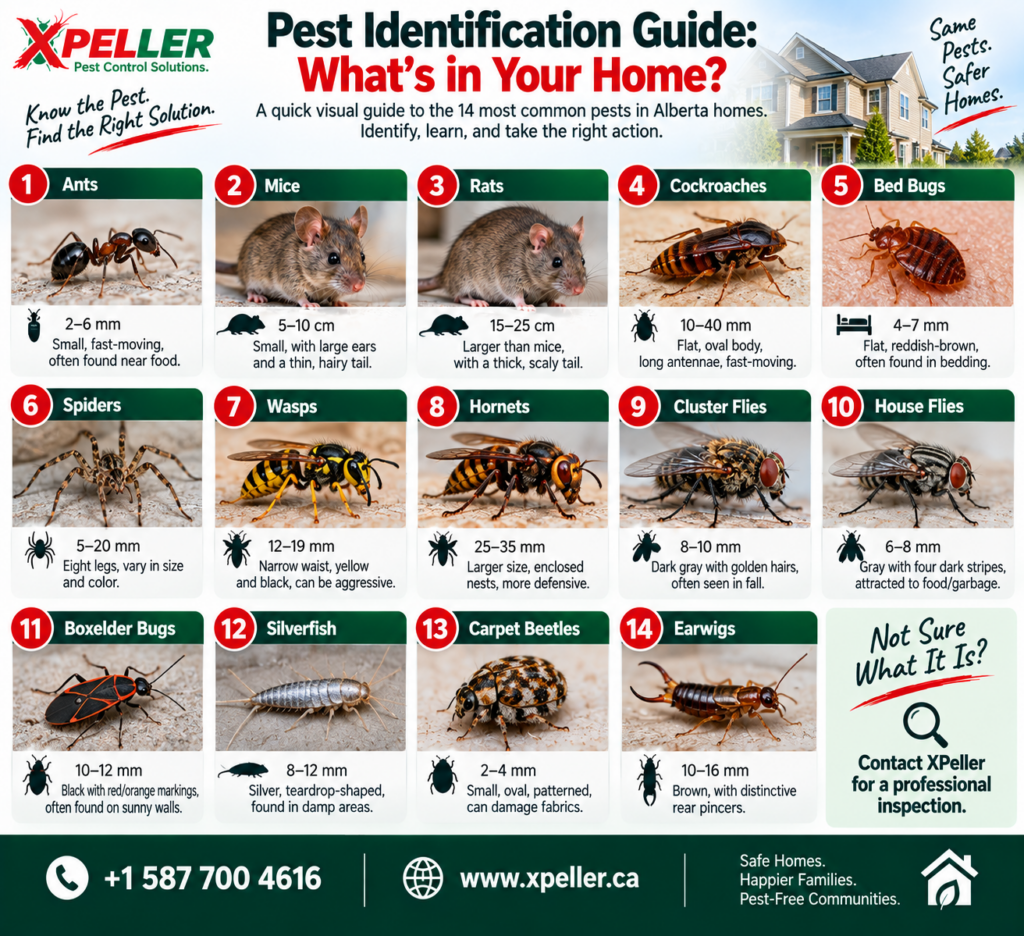
Ants
Small, six-legged insects ranging from 2-13mm depending on species, typically dark brown or black, moving in visible trails toward a food source. Carpenter ants are notably larger than common household ants and can cause structural damage. See our carpenter ants vs. regular ants comparison for a detailed breakdown.
Bed Bugs
Small, flat, reddish-brown insects roughly 4-5mm long, oval-shaped, visible to the naked eye. Look for small blood spots on bedding, dark fecal spots along mattress seams, and a sweet, musty odor in heavily infested areas.
Boxelder Bugs
Black with distinctive reddish-orange markings along the edges of their wings, roughly 12-14mm long. Appear in large numbers on sun-warmed exterior walls in fall, seeking entry to overwinter. See our full Boxelder Bugs 101 guide for identification and prevention.
Cluster Flies
Dark gray with fine golden hairs on the thorax, slightly larger and slower-moving than house flies, often found clustering near windows in fall. See our cluster flies vs. house flies comparison for the full visual and behavioral differences.
Cockroaches
Flat, oval-shaped insects with long antennae, typically reddish-brown to dark brown depending on species, most active at night. Sightings during the day can indicate a larger, established population rather than an isolated incident.
Mice
Small rodents with large ears relative to body size, thin hairy tails, and pointed snouts, typically 12-20cm including tail. See our mice vs. rats identification guide for a full comparison against the larger rodent species they’re commonly confused with.
Spiders
Eight-legged arachnids varying widely in size and color depending on species; most found in Alberta homes are harmless, though correct identification matters if a bite or unusual marking is a concern.
Voles
Small, stocky rodents with short tails and small ears, often mistaken for mice but typically found outdoors in lawns and gardens rather than indoors, identifiable by visible surface tunnels and runways in grass.
Wasps & Hornets
Narrow-waisted, smooth-bodied flying insects with black and yellow (or black and white, for some hornets) markings. See our wasp vs. hornet identification guide for a detailed size and behavior comparison.
Skunks
Black with a distinctive white stripe pattern down the back, roughly cat-sized, most active at dawn and dusk. Identifiable by a strong, persistent odor even before a visual sighting.
Gophers
Small burrowing rodents identifiable primarily by mound-shaped dirt piles in lawns, rather than frequent visual sightings, since they spend most of their time underground.
Moles
Small, velvety-furred burrowing mammals identifiable by raised ridges of soil (surface tunnels) rather than the mound piles associated with gophers — a key distinction for correctly identifying which yard pest you have.
Yellow Jackets
Bright yellow and black striped, smooth-bodied, often building nests underground or in wall voids rather than the exposed paper nests typical of other wasps. More aggressive than common paper wasps when a nest is disturbed.
Maple Bugs
A regional name often used interchangeably with boxelder bugs in parts of Alberta — see our maple bugs vs. boxelder bugs comparison to confirm whether they’re the same insect you’re seeing.
Found your pest but not sure what to do next? A quick inspection can confirm it and recommend the right approach.
📞 Call Us Now
💬 Chat on WhatsApp
📝 Get a Free Quote
Frequently Asked Questions
What should I do if I can’t identify a pest from a description alone?
A photo (from a safe distance) is often enough for a professional to confirm identification, or an in-person inspection can be scheduled for anything found indoors that’s difficult to photograph.
Are all household pests in Alberta dangerous?
No — many, like spiders and cluster flies, are more of a nuisance than a genuine risk, while others, like carpenter ants or an active wasp nest, warrant faster attention.
Can two different pests be mistaken for each other easily?
Yes — mice vs. rats, wasps vs. hornets, and boxelder bugs vs. maple bugs are among the most commonly confused pairs, which is why size, color pattern, and behavior all matter for a confident identification.
Conclusion
Identifying a pest correctly is the first real step toward solving the problem — the sections above cover the core visual and behavioral clues for the 14 pests most commonly found in Alberta homes.
Still not sure exactly what you’re looking at? That’s exactly what a quick professional inspection is for.
📞 Call Us Now
💬 Chat on WhatsApp
📝 Get a Free Quote
XPeller proudly serves Calgary, Edmonton, Lethbridge, and communities across Alberta.