
Finding droppings in your pantry or hearing scratching in the walls tells you something’s in your home — but it doesn’t tell you what, and mice and rats require noticeably different approaches to remove safely. Mice and rats are different rodent species with distinct physical traits, droppings, and behavior patterns, and correctly identifying which one you’re dealing with directly affects how the problem should be treated. In our service calls across Alberta, misidentification is common — homeowners frequently assume “rat” when it’s actually a mouse, or underestimate a genuine rat problem because the signs seemed too small. This guide breaks down exactly how to tell mice and rats apart, why the distinction matters, and what to do once you know which one you have.
How do you tell the difference between mice and rats?
Mice are smaller, with larger ears relative to their body and thin, hairy tails, while rats are considerably larger, with thicker bodies and hairless, scaly tails. Droppings also differ — mouse droppings are small and rice-grain sized, while rat droppings are noticeably larger and more capsule-shaped. Behavior differs too: rats are typically more cautious of new objects, while mice explore more readily.
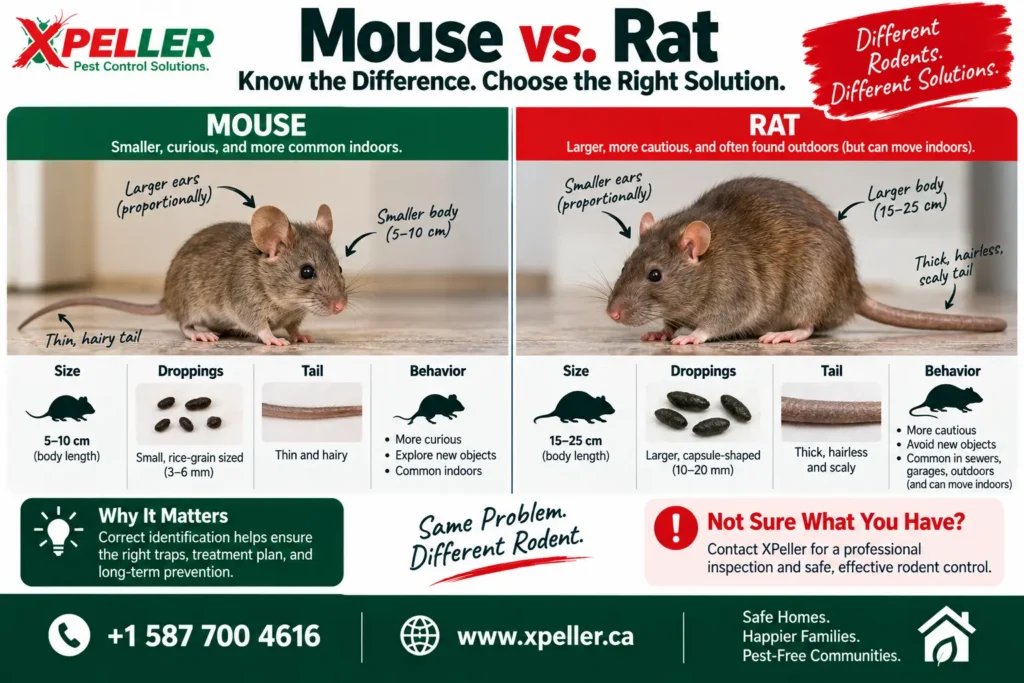
What Are the Physical Differences Between Mice and Rats?
The clearest identification method, when a live rodent or a clear photo is available, comes down to a few consistent physical traits:
| Trait | Mouse | Rat |
| Body size | 12-20 cm including tail | 32-46 cm including tail |
| Ears | Large relative to head | Smaller relative to head |
| Tail | Thin, hairy | Thick, hairless, scaly |
| Snout | Pointed, triangular | Blunt, rounded |
| Droppings | Small, rice-grain shaped | Larger, capsule-shaped |
Since most homeowners never actually see the rodent itself, droppings and gnaw marks are usually the more practical way to tell them apart — our earlier post on the signs mice leave behind covers what mouse-specific evidence typically looks like in more detail.
How Do Mice and Rats Behave Differently?
Beyond appearance, behavior offers useful clues, especially when you’re relying on sounds or activity patterns rather than a direct sighting:
- Mice are naturally curious and will explore new objects placed in their environment relatively quickly, which is why mouse traps often work faster than expected
- Rats are more cautious, often avoiding new objects (including traps) for several days before approaching, a behavior known as neophobia
- Mice tend to travel shorter distances from their nest, often staying within a small area
- Rats typically travel farther and can establish burrows outdoors in addition to indoor nesting
- Both are nocturnal, so scratching sounds from either are typically heard at night rather than during the day
This difference in caution level is one reason DIY trapping sometimes works well for mice but struggles against an established rat population — traps set without addressing this behavior pattern often go untouched for days.
What Do Mice and Rat Droppings Look Like?
Droppings are often the fastest way to confirm which rodent you’re dealing with, without needing to spot the animal itself:
- Mouse droppings — roughly the size of a grain of rice, pointed at both ends, found in scattered clusters near food sources
- Rat droppings — noticeably larger, about the size of a raisin or small olive pit, blunt or rounded ends, often found along consistent travel paths
- Freshness matters — fresh droppings are dark and moist-looking, while older droppings appear grey and dry, which can help estimate how recent the activity is
If you’re finding droppings but unsure which type, comparing them against a reference size (like a grain of rice vs. a raisin) is usually enough to make a confident identification.
Why Does It Matter Which Rodent You Have?
The distinction affects the right response in several practical ways:
- Entry points differ in size — rats need a gap roughly the size of a quarter to enter, while mice can fit through openings as small as a dime, meaning sealing strategies differ
- Trap placement and bait differ — rat traps are larger and rat bait stations are typically positioned differently due to their more cautious behavior
- Population growth speed differs — both reproduce quickly, but a delayed response to a rat problem can escalate into a more difficult removal situation given rats’ larger size and burrowing tendencies
- Health risk considerations — both carry disease risk, but the specific precautions during cleanup can differ depending on species
Misidentifying a rat problem as “just mice” often means using an approach that isn’t matched to the actual pest, which is part of why our full mouse control process starts with confirming exactly what species is present before any treatment begins.
Not sure if it’s mice or something bigger? We’ll confirm it during a quick inspection.
📞 Call Us Now
💬 Chat on WhatsApp
📝 Get a Free Quote
Can You Have Both Mice and Rats at the Same Time?
Yes — while less common, both species can be present on the same property, particularly on larger properties or those near open fields, waterways, or agricultural areas common around Alberta’s smaller towns. If droppings vary noticeably in size across different areas of the property, this is worth flagging during an inspection rather than assuming a single, uniform infestation.
When Should You Call a Professional for Rodent Identification?
A professional inspection is the most reliable option any time you’re uncertain, since correctly identifying the species affects the entire treatment approach — from entry-point sealing to trap type and placement. This is especially worth doing if droppings or damage seem larger than expected, or if DIY mouse traps have gone untouched for several days, which can indicate a more cautious rat population rather than mice. Our rodent control team in Calgary and Edmonton confirms species during inspection before recommending treatment.
Frequently Asked Questions
Can mice and rats be found in the same house?
Yes, though less commonly — this typically happens on larger properties or those near fields, water sources, or agricultural land.
Are rat droppings dangerous to clean up?
Both mouse and rat droppings can carry health risks, so proper precautions (ventilation, gloves, avoiding dry-sweeping) are recommended regardless of species.
Do rats and mice use the same entry points?
Not always — rats need a larger gap to enter than mice, so a home sealed only against mice may still be vulnerable to rats through slightly larger openings.
Is it more serious to have rats than mice?
Both require prompt attention, but rats are generally larger, more cautious, and can be more difficult to trap without professional-grade equipment and placement.
Conclusion
Telling mice and rats apart comes down to a few consistent clues — size, tail type, dropping shape, and behavior — and getting the identification right matters more than it might seem, since it shapes the entire approach to solving the problem.
Take a look at the droppings or damage you’ve noticed — do they match the smaller, mouse-sized signs, or something larger?
📞 Call Us Now
💬 Chat on WhatsApp
📝 Get a Free Quote
XPeller proudly serves Calgary, Edmonton, Lethbridge, and communities across Alberta.