
A fly buzzing lazily along your windowsill in October looks a lot like the one that bothered you at a summer barbecue, but the two are often not the same insect at all. Cluster flies and house flies are frequently confused, but they differ in size, color, behavior, and — most importantly — why they’ve ended up inside your home. In our service calls across Alberta, fall is when this confusion peaks, since cluster flies specifically move indoors this time of year in large numbers looking for a place to overwinter, while house flies tend to be a year-round nuisance tied to a different cause entirely. This guide breaks down exactly how to tell them apart, why each one shows up, and what the distinction means for how you should respond.
What is the difference between cluster flies and house flies?
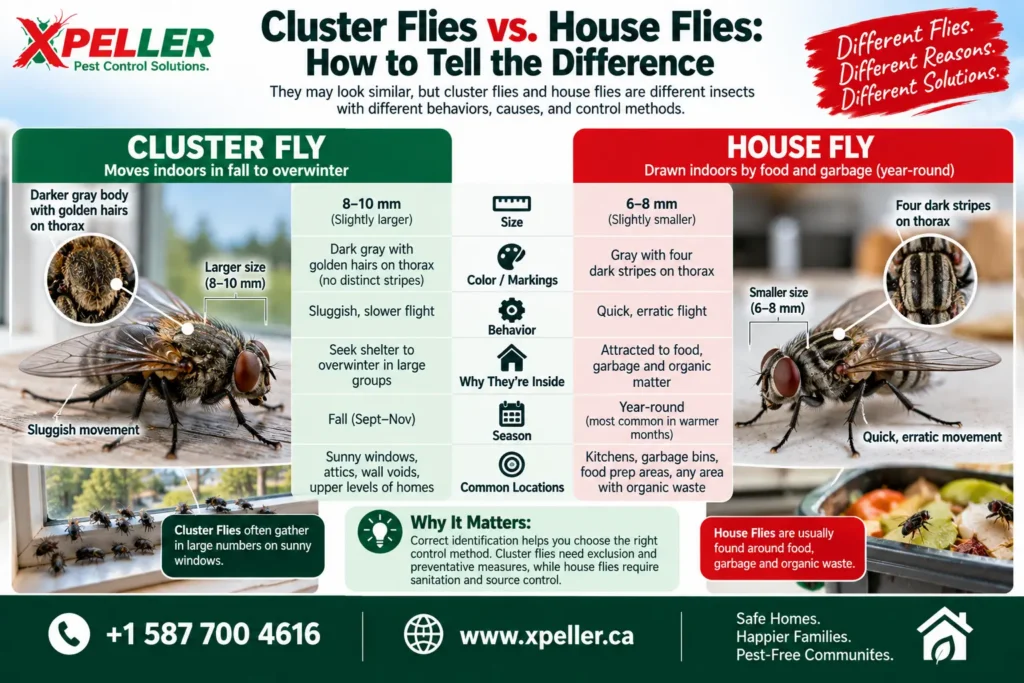
Cluster flies are slightly larger, dark gray with golden hairs on their thorax, and move indoors in fall to overwinter in large groups, while house flies are smaller, have four dark stripes on their thorax, and are typically drawn indoors by food or garbage year-round. Cluster flies fly sluggishly and often gather in sunny windows, while house flies move quickly and erratically.
What Do Cluster Flies Look Like?
Cluster flies are roughly 8-10mm long, slightly larger than a typical house fly, with a dark gray to black body and fine golden or yellowish hairs covering the thorax that give them a faintly fuzzy appearance up close. At rest, their wings overlap completely along their back rather than sitting flat, which is one of the more reliable visual distinctions if you can get a close look.
Their movement is also distinctive — cluster flies are noticeably slow and sluggish fliers, often bumping repeatedly into windows or walls rather than darting around a room the way other flies do.
What Do House Flies Look Like?
House flies are smaller, typically 6-7mm long, with a lighter gray body marked by four distinct dark stripes running down the thorax. Unlike the sluggish movement of cluster flies, house flies are fast, erratic fliers, capable of quick directional changes that make them noticeably harder to swat or catch.
House flies also lack the fine golden hairs seen on cluster flies, giving them a smoother, more uniform grey appearance.
Why Do Cluster Flies Show Up in Fall Specifically?
Cluster flies have a life cycle tied closely to outdoor conditions — their larvae are parasites of earthworms, developing outdoors during summer months. As temperatures drop in fall, adult cluster flies seek sheltered locations to overwinter, and homes offer exactly the kind of protected space they’re looking for. They typically enter through small gaps around windows, siding, or roofline areas, then cluster in large numbers in attics, wall voids, or unused rooms — hence the name.
This seasonal pattern is a big part of why cluster fly sightings spike specifically in September and October, then often reappear briefly again in early spring as the same flies attempt to leave their overwintering spots. If you’re noticing other fall-specific pest activity at the same time, our guide on signs mice are moving into your home this fall covers a similar seasonal pattern driven by the same temperature shift.
Why Do House Flies Show Up in a Home?
Unlike cluster flies, house flies aren’t drawn indoors by a seasonal instinct to overwinter — they’re typically drawn in by an active food or breeding source, such as exposed garbage, pet waste, decaying organic matter, or unsealed food. House fly presence, especially in larger numbers, often points to a specific attractant somewhere on or near the property that needs to be identified and addressed, rather than a seasonal pattern that will naturally resolve.
This distinction matters practically: a cluster fly problem in October is a sealing/exclusion issue, while a house fly problem at any time of year is usually a sanitation issue.
Why Does the Difference Actually Matter?
Correctly identifying which fly you’re dealing with changes the right response entirely:
- Cluster flies don’t breed indoors and don’t pose a sanitation risk — the main issue is nuisance from large numbers clustering in living spaces, and the long-term fix is sealing exterior entry points before the following fall
- House flies can be associated with unsanitary conditions since they breed in decaying organic matter, and their presence in numbers is worth investigating as a potential hygiene or attractant issue, not just an entry-point problem
- Treatment approach differs — cluster fly control focuses on exclusion (sealing gaps, screening vents) since spraying indoors only addresses visible flies without solving the seasonal cause, while house fly control focuses on removing the attractant and breeding source directly
Misidentifying one for the other can lead to treating the wrong problem entirely — sealing gaps won’t help an active house fly infestation tied to a garbage issue, and eliminating a food source won’t stop cluster flies from returning the following fall if entry points remain open.
Not sure which fly you’re dealing with? A quick inspection can confirm it and point to the right fix.
📞 Call Us Now
💬 Chat on WhatsApp
📝 Get a Free Quote
Can You Have Both Cluster Flies and House Flies at Once?
Yes — it’s possible, particularly in fall when cluster flies are actively seeking entry while a separate sanitation issue could independently be attracting house flies. If you’re seeing large, slow-moving flies clustering near windows and smaller, fast-moving flies elsewhere in the home, this is worth flagging as two separate issues during an inspection rather than assuming a single cause.
Are Cluster Flies or House Flies Dangerous?
Neither is considered medically dangerous in the way a stinging or biting pest would be, but house flies carry a higher hygiene concern since they can pick up and transfer bacteria from the decaying matter they breed in. Cluster flies pose essentially no health risk beyond nuisance, though large clusters can leave a noticeable odor if crushed, since they release a defensive scent similar to some other fall-invading insects, like boxelder bugs. For homeowners weighing whether DIY spraying is worth it for either fly, our comparison of DIY vs. professional pest control approaches applies here too, since spraying visible flies rarely addresses the underlying cause for either species.
Frequently Asked Questions
Do cluster flies bite?
No, cluster flies don’t bite people or pets — they’re a nuisance pest due to their numbers and sluggish indoor presence, not a health or safety risk.
Why do cluster flies gather near windows?
Cluster flies are drawn to light and warmth, which is why they often congregate on sunny windows, particularly on the south or west side of a home during fall and again in early spring.
Will cluster flies come back every year?
Yes, unless entry points are sealed — cluster flies (and often their offspring) tend to return to the same overwintering sites year after year if the access points remain open.
How do I get rid of house flies indoors quickly?
Removing the food source or breeding material they’re drawn to is more effective long-term than spraying, since new flies will continue appearing as long as the attractant remains.
Conclusion
Cluster flies and house flies might look similar from a distance, but their size, markings, flight pattern, and — most importantly — the reason they’ve shown up are genuinely different, which means the right fix depends entirely on correct identification first.
Take a closer look at the flies you’re seeing — are they slow and gathering near a window, or fast and appearing near food or garbage? That alone tells you most of what you need to know.
📞 Call Us Now
💬 Chat on WhatsApp
📝 Get a Free Quote
XPeller proudly serves Calgary, Edmonton, Lethbridge, and communities across Alberta.