
Standing in the pest control aisle with a can of spray in your hand, it’s hard to know if you’re about to solve the problem or just delay it. DIY pest control can genuinely work for small, early-stage problems, but it often struggles with anything involving hidden nesting, multiple entry points, or an established colony — which is exactly where a store-bought fix tends to fall short. In our service calls across Alberta, one of the most common patterns we see isn’t a bad DIY attempt, it’s a reasonable one that simply couldn’t address what was happening behind a wall or under a foundation. This guide breaks down what DIY pest control actually handles well, where it consistently falls short, and how to tell which situation you’re in before you spend money on the wrong approach.
Is DIY pest control as effective as professional treatment?
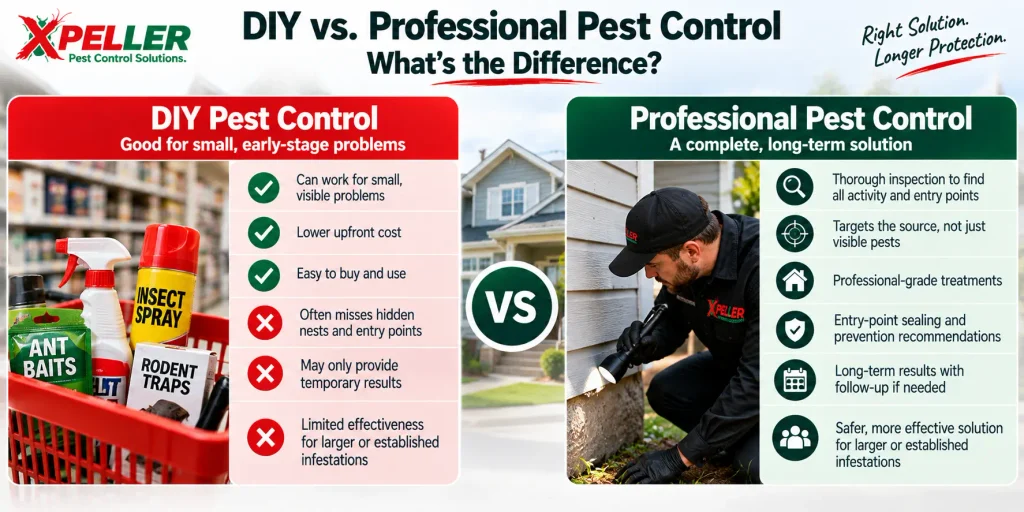
DIY pest control can be effective for small, visible, early-stage problems, but it typically can’t identify hidden entry points, nesting locations, or the full extent of an infestation the way a professional inspection can. A treatment that only addresses visible pests without finding the underlying cause often results in the same problem returning within weeks or months.
What Does DIY Pest Control Actually Handle Well?
DIY methods are genuinely effective in specific, limited situations:
- Small, isolated incidents — a single wasp nest spotted early, a few ants near a windowsill
- Visible, accessible problems — pests you can see and directly treat, not ones hidden in walls or underground
- Early-stage activity — before a colony has fully established or reached peak population
- Low-risk pests — nuisance insects without a sting/bite risk that complicates safe removal
For a small, early, visible problem, a DIY approach can resolve the issue without needing to escalate further.
Where Does DIY Pest Control Typically Fall Short?
The limitations tend to show up in a consistent pattern across almost every pest type:
- Hidden entry points go unaddressed — spraying visible pests doesn’t close the gap they came through, so new activity can start again. Our guide on how mice get into homes and how to seal entry points covers this exact problem for one specific pest, but the underlying issue — treating symptoms instead of the source — applies broadly.
- Nesting or breeding sites aren’t found — a product that kills visible pests doesn’t reach a nest inside a wall void or attic
- Scale is underestimated — what looks like a small problem from the outside is often larger once an inspection actually opens up the area
- Timing and application matter more than people expect — for example, our post on DIY wasp removal covers how something as simple as treating a nest during the day instead of at night can turn a manageable task into a genuinely dangerous one
What Does a Professional Inspection Add That DIY Can’t?
A professional inspection is built to find what a surface-level DIY attempt typically misses:
- A full property check — not just the room where activity was noticed, but adjacent areas where pests may be traveling from
- Entry-point identification — the actual access points, not just the visible symptoms
- Species-specific treatment — correctly identifying what you’re dealing with changes the right approach significantly. Our mice vs. rats identification guide is a good example of how misidentifying a pest can lead to using the wrong method entirely
- A follow-up plan — confirming the treatment actually worked, rather than assuming it did
Not sure if your situation is a DIY job or something bigger? A quick inspection gives you a clear answer either way.
📞 Call Us Now
💬 Chat on WhatsApp
📝 Get a Free Quote
How Do You Know Which Situation You’re In?
A few honest questions can help clarify this before spending money on either approach:
- Is the activity visible and isolated, or have you noticed signs in multiple areas of the property?
- Have you already tried a DIY fix that worked briefly, then the problem came back?
- Is the pest type one with real risk (stinging insects, an allergy concern, structural damage potential) rather than just a nuisance?
- Can you actually see and reach the source, or is the activity coming from somewhere hidden?
If the honest answer leans toward multiple signs, a repeat problem, real risk, or a hidden source, that’s generally the point where a professional inspection becomes the more reliable option.
Is It Ever Worth Trying DIY First?
For a genuinely small, early, visible, low-risk situation, yes — there’s little downside to trying a reasonable DIY approach first, as long as you’re realistic about reassessing if it doesn’t fully resolve the problem within a short window. The risk isn’t in trying DIY first, it’s in repeating the same DIY attempt multiple times without the problem actually resolving, which usually means the underlying cause hasn’t been addressed.
When Does Waiting on DIY Become Costly?
Delaying professional treatment while a DIY approach isn’t working can allow a smaller issue to become a more established one — particularly for pests that reproduce quickly or cause ongoing property damage the longer they’re active. If you’re on your second or third DIY attempt at the same problem, that’s generally a sign the situation needs a different approach, not just another try.
Our full pest identification guide can help confirm exactly what you’re dealing with if you’re still not sure, which is often the first real step toward knowing whether DIY is still a reasonable option.
Frequently Asked Questions
Does DIY pest control ever make a problem worse?
It can, indirectly — if a DIY attempt disturbs a nest or colony without fully addressing it, activity can sometimes become more active or spread to a new area before settling.
Is professional pest control always more expensive than DIY?
Upfront, usually yes, but DIY products that need to be repurchased after a recurring problem can add up, sometimes costing more over time than a single professional treatment that addresses the source.
Can I combine DIY and professional treatment?
Sometimes — for example, sealing obvious gaps yourself while scheduling a professional inspection for harder-to-reach entry points can be a reasonable combined approach.
How do I know if a DIY product actually worked?
Monitor the area for at least a couple of weeks — if signs of activity reappear, that’s usually an indication the underlying source wasn’t addressed.
Conclusion
DIY pest control isn’t right or wrong on its own — it depends entirely on whether the problem is small and visible, or hidden and established, since those two situations call for genuinely different approaches.
Looking at your own situation honestly — does it match the small, early, visible pattern DIY handles well, or has it already shown signs of being bigger than that?
📞 Call Us Now
💬 Chat on WhatsApp
📝 Get a Free Quote
XPeller proudly serves Calgary, Edmonton, Lethbridge, and communities across Alberta.