
Most Edmonton homeowners don’t spot a wasp nest until they’ve already walked past it dozens of times. Wasps consistently choose the same handful of spots around a property — sheltered, elevated, and close to a food source — which means knowing where to look is often more useful than knowing what a nest looks like. In our service calls across Edmonton, the majority of nests we remove show up in one of just five common locations, year after year. This guide walks through exactly where to check around your home, why wasps favor these spots, and what to do once you’ve found one.
Where do wasps usually build nests around homes?
Wasps most commonly nest under roof eaves, inside wall or attic voids, in sheds and garages, underground in yard burrows, and inside outdoor structures like fences or playground equipment. These locations share three traits wasps look for: shelter from weather, minimal disturbance, and proximity to food sources like garbage bins or gardens.
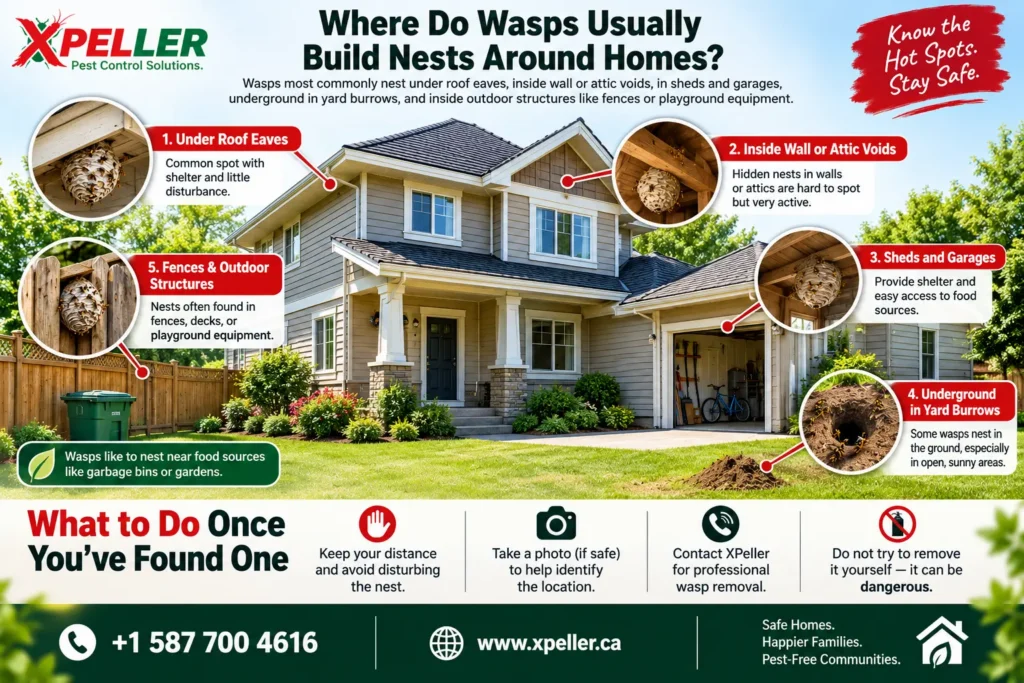
1. Under Roof Eaves and Soffits
Roof eaves are the single most common wasp nesting spot on Edmonton homes. The overhang provides shelter from rain and wind while staying elevated and away from ground-level disturbance — ideal conditions for both paper wasps and larger colonies.
Nests here are often visible from the ground if you know to look, appearing as a small grey or tan papery structure tucked against the underside of the roofline. Because this is such a frequent Edmonton wasp control call, our wasp and hornet team checks eaves first during any property inspection.
2. Inside Wall Voids and Attics
Wall cavities and attic spaces offer wasps near-total protection from weather and predators, which is exactly why these nests are also the hardest to detect early. A colony can grow significantly before any sign appears indoors — often a faint buzzing sound or a few wasps finding their way inside through a gap.
By the time a wall-void nest is noticed, it’s frequently larger than an exposed nest would be at the same point in the season, which is part of why understanding fall wasp danger matters — hidden nests reach peak size with no visible warning.
3. Sheds, Garages, and Unused Vehicles
Outbuildings and rarely-opened spaces are attractive to wasps for the same reason they’re attractive to homeowners avoiding a mess — they’re undisturbed for long stretches. Corners of a garage, the inside of a shed roofline, or even the wheel well of a vehicle that hasn’t moved in weeks are all common Edmonton nesting spots.
These locations often go unchecked until someone opens the space for a specific task, at which point they can encounter an unexpectedly mature colony with little warning.
4. Underground Burrows
Ground-nesting wasps, particularly yellow jackets, build nests in abandoned rodent burrows, loose soil near garden beds, or under decks and patios. These nests are especially risky because they’re easy to disturb accidentally — stepping near the entrance, mowing over it, or digging in the yard can trigger a defensive swarm with very little advance notice.
If you’re unsure whether a ground nest belongs to yellow jackets specifically, our wasp vs. hornet identification guide covers how to tell the difference before deciding on next steps.
5. Fences, Playground Equipment, and Hollow Structures
Any hollow outdoor structure — fence posts, deck railings, children’s play structures, even mailboxes — can become a nesting cavity. These spots are particularly worth checking before letting kids play outside for extended periods in late summer and fall, since a disturbed nest in play equipment poses direct risk to children.
Why Do These 5 Locations Come Up So Often?
Across all five spots, the pattern is consistent: shelter, minimal human disturbance, and proximity to food. Understanding this pattern is more useful long-term than memorizing a list, since it lets you evaluate any new structure or space on your property with the same logic — asking whether it offers cover, goes unchecked for long periods, and sits near a food source.
When Should You Have These Areas Professionally Inspected?
A professional inspection is worth scheduling before opening up rarely-used spaces (sheds, attics, storage areas) for the season, and immediately if you notice repeated wasp activity around any of these five locations. If you’re in Edmonton, our wasp nest removal service can check all five common spots in a single visit.
Frequently Asked Questions
Do wasps nest in the same spot every year?
No, wasps don’t reuse old nests, but the same locations on a property are often chosen again by new colonies since the underlying conditions (shelter, food access) haven’t changed.
Can wasps get into a house through small gaps?
Yes — gaps around vents, soffits, or utility penetrations are common entry points that can lead to nesting inside wall voids or attics.
How can I prevent wasps from nesting around my home?
Regularly checking eaves, sealing gaps, keeping garbage bins covered, and inspecting rarely-used outdoor structures each spring can reduce the chance of a nest establishing.
Are ground nests more dangerous than nests in trees or eaves?
Ground nests carry unique risk because they’re easy to disturb accidentally, often triggering a faster, less predictable defensive response than an exposed nest you can see coming.
Conclusion
Knowing where wasps typically nest turns a vague “check around your property” into a specific, actionable checklist — eaves, wall voids, outbuildings, underground burrows, and hollow structures cover the vast majority of Edmonton wasp activity we see each season.
Have you checked all five of these spots around your own home recently, or is there one area you’ve been putting off inspecting?
📞 Call Us Now
💬 Chat on WhatsApp
📝 Get a Free Quote
XPeller proudly serves Calgary, Edmonton, Lethbridge, and communities across Alberta.