
Most people call every black-and-yellow stinging insect a “wasp,” but that assumption can actually lead to the wrong response when one shows up on your property. Wasps and hornets are related but behave differently — hornets are generally larger, more aggressive when disturbed, and build enclosed paper nests, while common wasps are smaller and more likely to build open, umbrella-shaped nests. In our service calls across Alberta, misidentifying which one you’re dealing with is one of the most common reasons homeowners either overreact to a harmless wasp or underestimate a genuinely dangerous hornet nest. This guide breaks down exactly how to tell them apart, why the distinction actually matters for your safety, and what to do once you’ve correctly identified which one you’re facing.
What is the difference between a wasp and a hornet?
Hornets are a specific, larger type of wasp — every hornet is technically a wasp, but not every wasp is a hornet. Hornets typically measure 25-35mm, build large enclosed paper nests, and deliver a more painful sting, while common wasps like yellow jackets are smaller, more numerous, and often build exposed or ground-level nests. The distinction matters most for assessing sting risk and choosing the right removal approach.
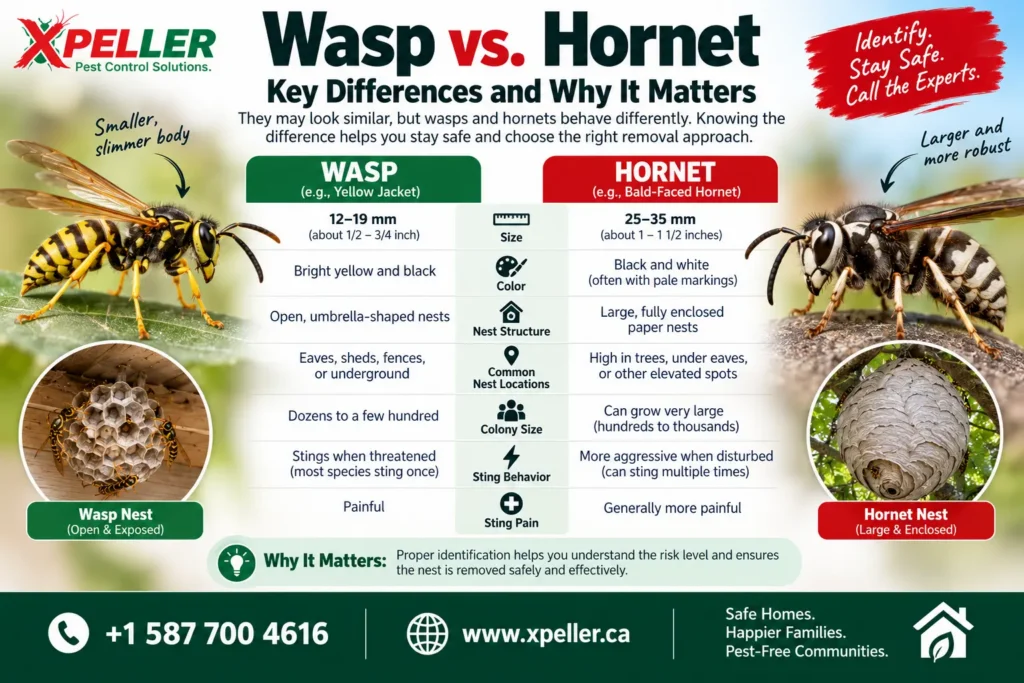
What Makes a Hornet Different From a Wasp?
Hornets belong to the genus Vespa, making them a specific subgroup within the broader wasp family. The key physical and behavioral differences include:
- Size — hornets are noticeably larger, often 25-35mm compared to 12-19mm for common wasps
- Nest structure — hornets build large, fully enclosed paper nests, often high in trees or under eaves, while many wasps build smaller, open, umbrella-shaped nests
- Colony size — hornet colonies can grow larger by season’s end than typical wasp colonies
- Sting behavior — hornets can sting repeatedly and tend to be more defensive of their nest when it’s disturbed
Not every large stinging insect people call a “hornet” in Alberta is a true hornet species — many are actually large yellow jacket colonies, which is part of why proper identification matters before deciding how to respond. If you’re unsure which one you’re dealing with, our wasp nest removal guide covers the warning signs to look for before approaching.
How Can You Tell a Wasp Nest From a Hornet Nest?
Nest appearance is often the fastest way to tell the two apart without getting close enough to identify the insect itself:
- Hornet nests — large, grey or brown, fully enclosed paper structures, typically shaped like an upside-down teardrop, usually built well off the ground
- Yellow jacket nests (often mistaken for hornets) — commonly built underground or in wall voids, not usually visible from outside
- Paper wasp nests — small, open, umbrella-shaped combs with visible individual cells, usually under eaves or railings
Because hornet and large yellow jacket nests can look similar from a distance, and both can be significantly more dangerous than a small paper wasp nest, distance is the safest first step — approach for identification only if the nest is small, low, and clearly a paper wasp structure.
Why Does It Matter Which One You’re Dealing With?
The distinction isn’t just academic — it directly affects the level of risk and the right response:
- Sting severity — hornet stings tend to be more painful and can deliver more venom per sting than common wasps
- Colony aggression — hornets and yellow jackets are generally more defensive of their nests than solitary or small paper wasp colonies
- Removal approach — a small paper wasp nest may occasionally be manageable with caution, while hornet and large yellow jacket colonies typically require professional-grade protective equipment
- Allergy risk — anyone with a known stinging-insect allergy should treat any unidentified large nest as high-risk, regardless of species
This is also why our earlier post on why wasp nests get more dangerous in fall applies to hornets as well — the same fall population peak and food scarcity pattern drives both species to become more aggressive at the same time of year.
Are Hornets More Dangerous Than Wasps?
Generally, yes — hornets tend to be more dangerous due to their larger size, more painful sting, and more defensive colony behavior, though any large, disturbed colony of either species poses real risk. The insect species matters less in an emergency than the practical response: keep distance, avoid provoking the nest, and treat any large or hard-to-reach nest as a job for a professional rather than a DIY project.
For Calgary homeowners specifically, our wasp and hornet removal service handles both species using the appropriate method for the nest type and location, and our Edmonton team follows the same identification-first process.
Frequently Asked Questions
Is a hornet just a big wasp?
Yes — hornets are a specific, larger species within the wasp family, not a separate category of insect entirely.
Do hornets and wasps build nests in the same places?
Not usually — hornets tend to nest higher up and in more enclosed structures, while many wasps nest in smaller, open combs or underground.
Which stings more, a wasp or a hornet?
Hornets generally deliver more painful stings due to larger venom sacs, but both can sting multiple times and cause serious reactions in allergic individuals.
Can you have both wasps and hornets on the same property?
Yes — it’s possible to have multiple colonies of different species nesting in different areas of the same property at once.
Not sure if it’s a wasp or hornet nest on your property? We can identify it safely.
📞 Call Us Now
💬 Chat on WhatsApp
📝 Get a Free Quote
XPeller proudly serves Calgary, Edmonton, Lethbridge, and communities across Alberta.
Conclusion
Knowing the difference between a wasp and a hornet isn’t just trivia — it changes how seriously you should take a nest on your property and whether it’s safe to handle yourself. If you’ve spotted a large nest and aren’t sure what’s inside it, that uncertainty is exactly the moment to call in a professional rather than guess.
Have you noticed unusual nest activity around your home this season? It’s worth a closer look before the colony grows any larger.